Part 1: Ireland Huawei Tech Arena
2024 winter, Huawei hosted a series of competitions, Huawei Tech Arena. They are international competitions hosted by Huawei. The motive for hosting was, to accelerate innovation of cutting edge technical frontiers via having a large number of highly talented teams outside Huawei to compete and attempt solving them with different approaches and creativity. It also serves as a talent pipeline, as top teams are given opportunities to enter Huawei.
Kwun believes he could visit Huawei’s Irish cloud center, speak to its engineers, understand their technical direction and learn from them, the journey would be worth every hour. Kwun believes reading white papers offers generality, but not detailed truth.
I Begining
When the University of Sheffield sent the invitation to the Huawei Tech Arena, Kwun assembled a team within five hours: a “navy seal” of Sheffield engineers. We all had different languages, instincts, and time zones. Kwun asked Olivia to open a public room on the department Discord so the entire engineering department could see how every decision was made, live.
Tech Arena Ireland competes on algorithms for edge computing: In future compute clusters could be decentralised and be like local wifi signals instead of the centralising of all compute resources on a giant data center. Distributing those compute resources is an issue, and that’s what this tech arena is about..Participants develop algorithms to optimize an objective function. Tech arena comprises two stages: Stage 1 is a 30-day online competition; Stage 2 invites the top competitors from Stage 1 to compete and connect on-site.
In the very beginning, our team had doubts. Jamie read the rules and reported that the competition suggested each team should have at least one PhD. Artem said, “If we could get top 10 in this, it’s a pretty big deal.” “They are veterans,” Jamie said. “We don’t stand a chance.” “That,” Kwun answered, “is exactly why we can. They have experience, but also preconceptions. We will win by sheer speed and momentum.”
II Round 1
Our morale rose. For the next 10 days, it was constant failure and pressure to deliver. Every method was tried: linear programming, reinforcement learning, greedy algorithms, and each failed somehow. Narwar told Kwun, “The other teams, Manchester and Imperial, iterated ten times while Sheffield has not advanced once, we are seriously behind.”
Team morale began to collapse. Days of constant pressure burned Narwar out and he had to withdraw. The team stood on the edge of disbanding: nothing worked, we were behind, and one of our most capable members was gone. At that point, Kwun wrote the first working solution alone; we rose to one of the top teams. Huawei’s message arrived: we were among the leading 15 teams, and morale rose again. Kwun had also prepared backup members: Dennis, who had impressed him most on the ShefGuide project, joined and replaced Narwar. Within days, we climbed higher; Huawei’s next message arrived: we were now among the top leading 15 teams.
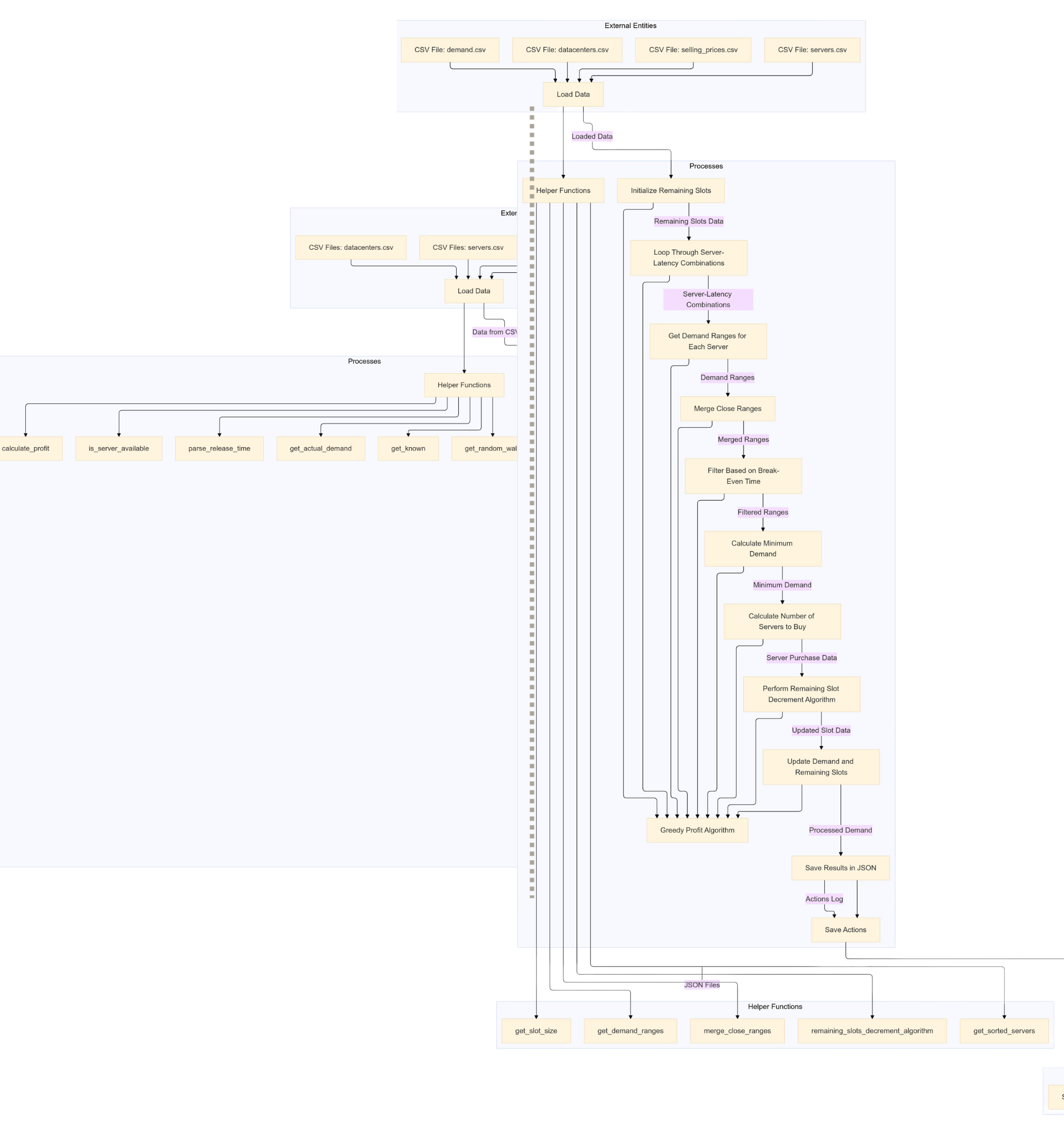 Figure 1 : Data Flow Diagram of first made Algorithm
Kwun reorganized the team. “If others move like research labs,” he said, “we will move like a startup.” The plan was simple:
- Build the simplest solution that runs.
- Build a better one.
- With that knowledge, build an even better one.
- While doing that, build a feedback loop and hypotheses to gain knowledge.
Speed of iteration should be prioritized above all else.
Kwun told the team, “All eyes are on you right now, so that when you’re back at Sheffield, your friends and peers will look at you and say: ‘Look! He is the best among us!’” Half the team would optimize and iterate; the rest would build feedback loops and test hypotheses. Omer ran experiments with linear programming and reinforcement learning. Within days, our team rose. Artem’s code cut computation time to a tenth, allowing rapid iteration. Jamie kept iterating better versions of the algorithm.
Kwun believes incentive is a superpower, so he set up an incentive system. Three days later productivity tripled again; Sheffield broke into the top ten, then rose to sixth place. We finished Stage 1 of Tech Arena in sixth place out of a few hundred teams and earned the ticket to Dublin for Stage 2, the final round. Huawei arranged £5,000 for our team’s travel. Jamie said, “I thought getting to this point was impossible. Turns out we’re stronger than we imagined.”
III The Final Round: Dublin
We had cleared Stage 1. Stage 2, the final match, would start two weeks later. During this period, Kwun assumed that others would make good use of the time to iterate and improve their algorithms.
Some of our teammates, Omar, Artem and Jamie, decided preparation was unnecessary; they believed any difficulty could be overcome on the day. Kwun told them that if they wouldn’t prepare, Dennis and he would go to Ireland. Dennis and Kwun began building infrastructure to reduce iteration time. When the final round began, the whole team caught up.
During the final round, Dennis and Kwun had built infrastructure that allowed the team of five to iterate faster than others. Omar, fascinated by the beauty of mathematical programming, separated from the main group to chase a linear solver that could win the competition if done right. Kwun warned him that this pursuit of perfection would divide the team’s focus and greatly increase pressure. Omar persisted; Artem followed.
Team “Wait But Why?”, comprised of five talented PhDs, won the competition for the third year in a row. Sheffield placed seventh out of a few hundred teams: an honorable finish, yet far from satisfying. Kwun told the rest, “Our team was stronger than ever. You all have gone further than you imagined just a month ago; you had no experience, not even confidence to try, 30 days ago. Some will say only nice words in the end; I’ll also be honest: as a team, we didn’t always live up to our responsibilities to each other.”
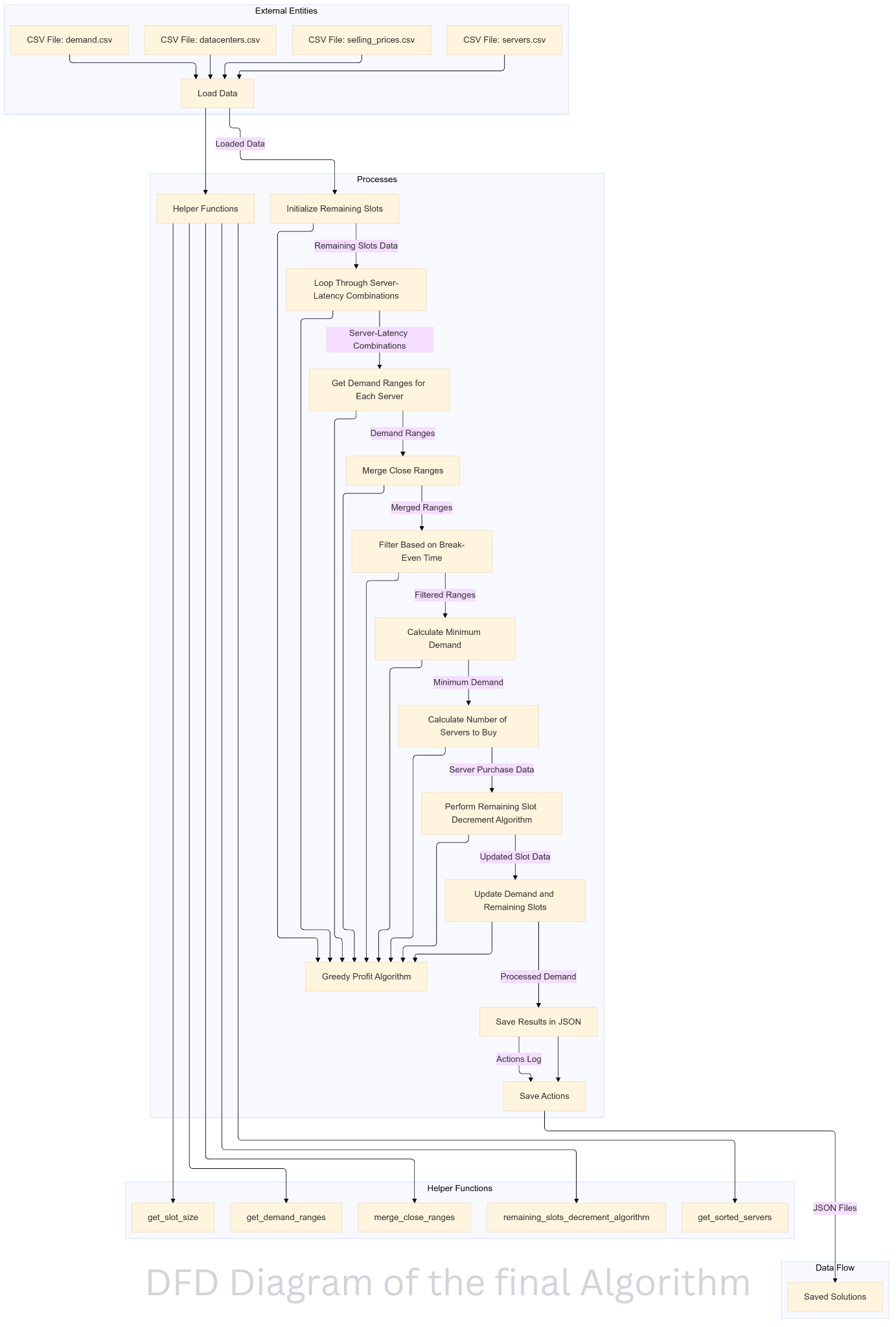 Figure 2 : Data Flow Diagram of final Algorithm, based off on greedy algorithm, ranking 7th most effective among hundreds of team in tech arena Ireland
After the competition, there were disagreements about contributions and credit. Some teammates said that Kwun had contributed little, or even that he could not code. When friends reached out to him about it, Kwun decided to speak with action. “Life is not long. I don’t have the luxury of spending time arguing. My actions should speak louder than words. I shall win an even harder competition, from an even fiercer pool of competitors, alone.” And thus, Kwun set sail on the U.K. Tech Arena, solo.
Part 2: U.K. Tech Arena
The U.K. Tech Arena ran approximately sixty days and focused on branch prediction, an algorithm important to CPU architecture, where predictors learn patterns from the past to predict the future. Kwun, meanwhile, had no experience in branch prediction or C++. He believed that winning an international competition solo, with no prior experience in the field or language, would be the best stress test of himself as an engineer.
Kwun moved fast, fiercely. Within three days, he produced a simple but working solution based on a Markov chain. By the seventh day he had iterated five times. By the tenth day, progress flattened. He learned that iteration alone would not be sufficient anymore; he decided to learn and implement the best-known algorithms in branch prediction history: TAGE and then Branchnet, the state-of-the-art combination at the time.
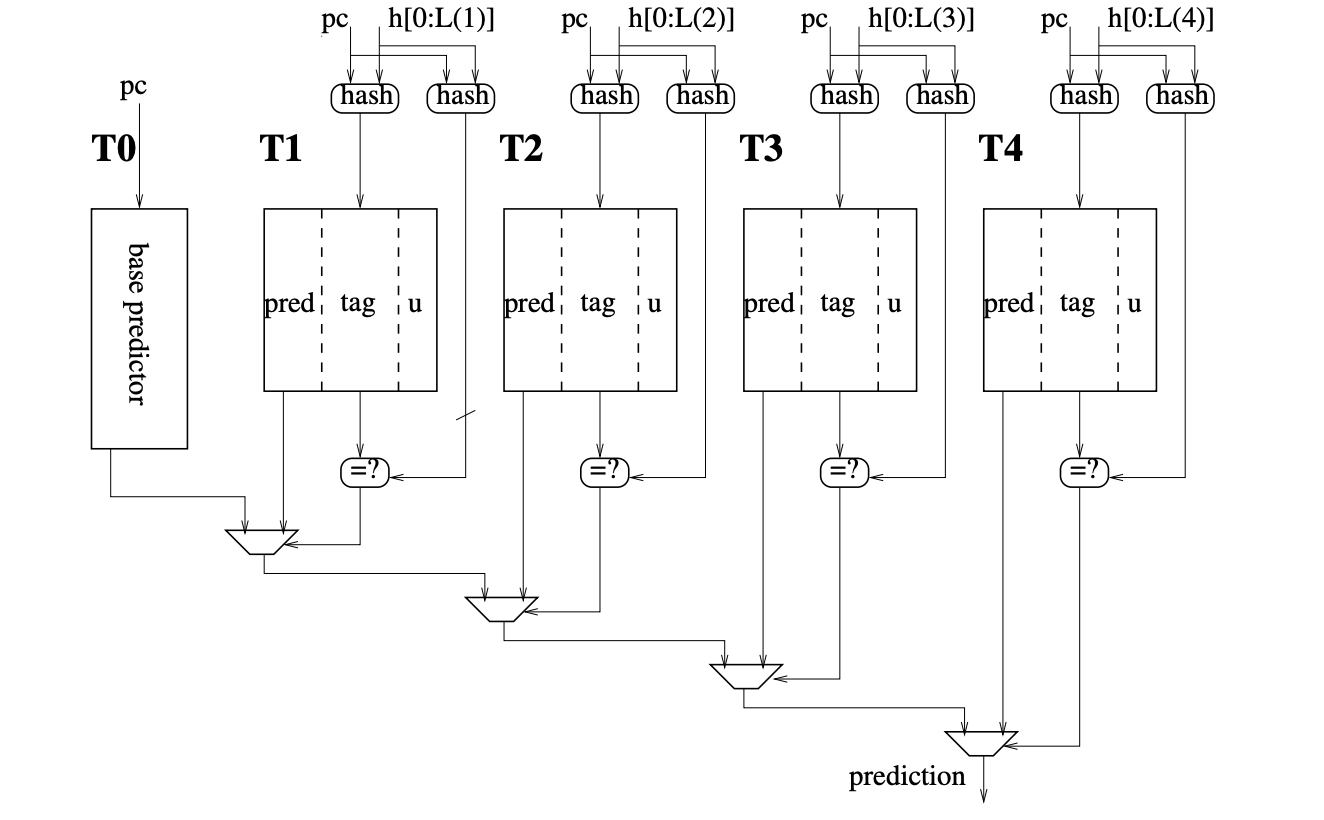 Figure 2 : Diagram of TAgged Geometric history length(TAGE) branch predictor, the state of art branch predictor, significantly boosting accuracy over previous generations of predictors by combining short and long history insights, making it crucial for high-performance CPU.
IV Pivot
With intense speed, by the 20th day of competition, Kwun had implemented a working version of TAGE and Branchnet. Surprisingly, test cases showed this still did not bring him close to winning.
He realized that Tech Arena existed to extend the frontier of state-of-the-art approaches; simply learning the best was not enough, he had to try to exceed it. With only 10 days left, he was still far from 10th place, let alone 1st.
Branch prediction, Kwun decided, is a classification problem in essence. It can be broken down into two parts: feature extraction and feedback. Extract meaningful patterns, then learn how much each pattern should weigh via feedback.
V The Breakthrough
Kwun understood the underlying technology of AI, deep neural networks, well, so he decided to build a neural-network-based predictor. After completion, he stripped all unnecessary parts: one thousand five hundred lines of code became about two hundred and fifty. He traded a little theoretical performance for a hidden decisive edge: less code and less complexity, so he could locate bottlenecks faster.
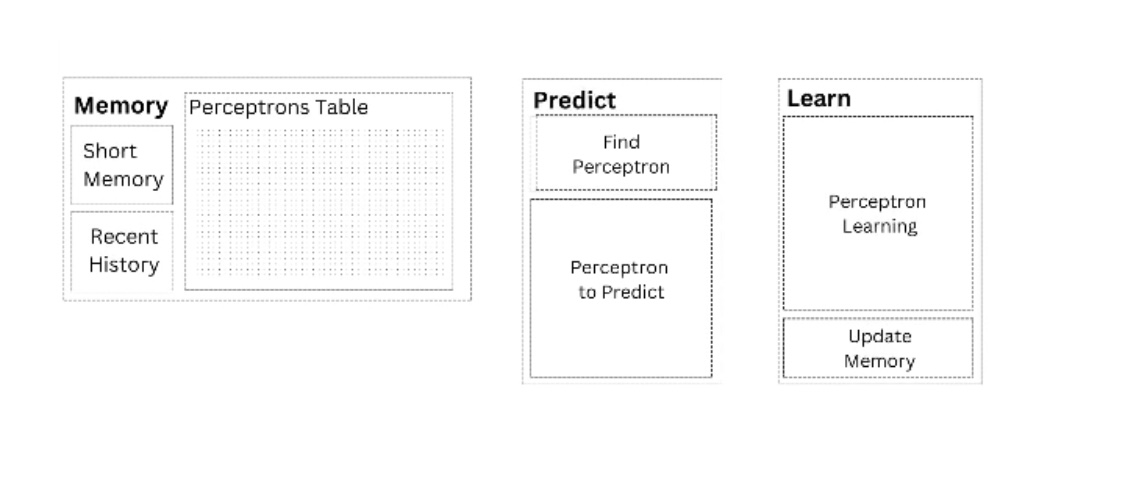 Figure 3 : Neural network based predictor, first place and best idea prize of the Huawei Tech arena UK 2024. It comprises 1024 perceptrons, each storing weight. Perceptron compresses history into weights and uses them to predict the future.
Then he built the infrastructure he believed would be decisive: a complete feedback chain. The time from new idea to verified result fell from an hour to about ten seconds, allowing him to test hypotheses faster than other competitors. He went all in on Boyd’s law: “In analyzing complexity, speed of iteration beats quality of iteration.”
Six days before the end, he restarted from zero and entered the top ten. Three days left, he fell out of the top ten. Twenty hours left, he was 15th. In the final hour, the numbers turned. Kwun took first place.
Huawei sent the invitation for the final stage of the U.K. Tech Arena. After Kwun won the first place and best idea prize, he received an invitation to join Huawei’s 2012 Laboratories to work on CPU architecture.